
If you have ever walked into a Saddleworld store in Australia, you already know the feeling. There are rows of saddles, confident staff, and a fitting service on offer. But a quiet question lingers: is that fitting genuinely in your horse’s best interest, or is it shaped by the stock on the shelves? Across Australian riding communities — from Queensland trail riders to Victorian dressage circles — this tension between franchise convenience and independent expertise keeps coming up.
This guide cuts through the noise. It covers how saddle fitting in Australia actually works, where franchise services shine and where they fall short, what a truly qualified fitter looks like, and why the distinction between mobile and in-store fitting matters far more than most riders realise.
Verified Fact
According to the Australian Government Department of Agriculture, Fisheries and Forestry, equine welfare standards explicitly recognise that ill-fitting equipment — including saddles — constitutes a welfare concern requiring remediation. Source: Australian Government Department of Agriculture, Fisheries and Forestry — Animal Welfare.
Choosing between a franchise outlet like Saddleworld and an independent saddle fitter in Australia is not simply a matter of convenience. It is a decision that directly affects your horse’s health, movement, and long-term performance. So, let us break it down properly.
Explore: Browse Cheval Sport’s full range of saddles and saddle accessories — sourced for Australian riders and conditions.
Why Saddle Fitting in Australia Deserves More Attention
Saddle fit is one of the most consequential decisions you make for your horse. A poorly fitted saddle restricts movement. It causes muscle soreness. Over time, it creates lasting physical damage. Yet many Australian riders only check their saddle fit when a problem is already obvious — a grumpy horse, a reluctant canter transition, or unexplained back tension.
The challenge is that saddle fitting is not a one-time event. Horses change shape continuously. A young horse in work looks completely different at five than it did at three. A broodmare returning to ridden work carries weight differently. Even seasonal conditioning affects how a saddle sits.
Quick Fact — Verified
The RSPCA Australia recognises that saddle pressure and poor fit are leading contributors to equine back pain and behavioural issues in ridden horses. Source: RSPCA Australia — Horse Care.
Additionally, rider weight, riding style, and girth fit all interact with the saddle. Consequently, a saddle that felt perfect twelve months ago may be causing discomfort today. This is why the question of who fits your saddle — and how — matters every single time.
In Australia, riders have two broad pathways: franchise-affiliated stores such as Saddleworld, and independent saddle fitters operating privately. Both have genuine merit. However, each comes with distinct advantages and limitations riders must understand before making a booking.
How Saddleworld Operates in Australia — and What That Means for Fitting
Saddleworld in Australia operates as a franchise network. Individual stores carry approved brands and product lines set by the franchise agreement. That structure is excellent for consistency, stock depth, and pricing accessibility. However, it creates an important constraint for saddle fitting specifically.
When you visit a Saddleworld store for a fitting, the fitter works only from that store’s available inventory. Even with the best intentions, the recommendation must come from what is on the shelf. If the saddle that perfectly suits your horse happens to be a brand outside the franchise range, that option simply will not arise during the appointment.
Verified Fact
According to Wikipedia’s article on saddle fitting, proper saddle fit assessment involves evaluating the tree width, panel contact, gullet clearance, and balance — all of which must be assessed against the individual horse, not a store’s available stock.
This does not mean franchise store fitting is worthless. For many riders buying a new saddle within a franchise’s range, it delivers real value. The staff are generally trained. The stock is handled, tried, and returned if unsatisfactory. Furthermore, the convenience of combining a purchase with a fitting in one visit appeals to busy horse owners.
Nevertheless, the structural bias is real. Riders who walk in without understanding this risk are the ones who leave with a saddle that is “close enough” rather than genuinely correct. Over time, “close enough” causes welfare problems.
Related: Explore Cheval Sport’s range of saddle pads and numnahs — a well-fitted pad complements a properly assessed saddle.
Franchise Store Fitting (e.g., Saddleworld)
- Fitting tied to in-store stock only
- Convenient — combined purchase and fitting
- Fitter training varies by location
- May offer complimentary fitting with purchase
- Limited brand flexibility
- Ideal for new saddle buyers within the range
Independent Saddle Fitter
- Brand-neutral assessment
- Can service any saddle regardless of brand
- Qualifications should be verified individually
- Typically charges a standalone fitting fee
- Often mobile — visits your property
- Ideal for objective assessment and adjustments
The Real Difference Between a Mobile Fitter and an In-Store Appointment
Many Australian riders are now choosing mobile saddle fitters — and for good reason. A mobile fitter comes to your property. They assess the saddle on your horse, in your arena or paddock, under the conditions the horse actually works in. This is fundamentally different from an in-store assessment.
In a store, measurements and saddle trees are assessed using tracings, templates, and occasionally foam impressions. These tools are valuable. However, they cannot capture how the saddle moves during work. They cannot observe how the horse travels differently on soft ground versus harder surfaces. They miss the dynamic elements of saddle fit that only emerge in motion.
By contrast, a mobile fitter watches the horse travel. They observe the saddle during walk, trot, and canter. They check rider position, saddle balance, and panel contact under real conditions. Consequently, the assessment is richer, more accurate, and more actionable.
Mobile fitting does carry a cost consideration. Many mobile saddle fitters in Australia charge a travel levy in addition to the fitting fee. However, for horses with complex fitting needs, high-value horses, or situations involving suspected saddle-related discomfort, the additional expense is typically justified.
Furthermore, mobile fitting removes the stress of transporting your horse to an unfamiliar environment. In an environment the horse knows, its movement is more natural, and the assessment is more representative of everyday ridden work.
Understanding Saddle Fitter Qualifications in Australia
Australia lacks a single mandatory national certification for saddle fitters. This creates a landscape where qualifications vary considerably between practitioners. Some fitters hold internationally recognised accreditations. Others have completed brand-specific training courses. And unfortunately, some operate with minimal formal training at all.
This matters because the title “saddle fitter” carries no protected status in Australia. Anyone can use it. Therefore, verifying a fitter’s credentials before booking is essential — not optional.
What to Look for in a Qualified Saddle Fitter
- Ask specifically which qualification they hold and from which issuing body.
- Check whether they hold Society of Master Saddlers accreditation or equivalent.
- Ask how recently they completed professional development or refresher training.
- Confirm they carry professional indemnity insurance for fitting services.
- Request references from current clients in your discipline or region.
- Ask whether they assess saddles dynamically — in motion — not only statically.
In franchise environments such as Saddleworld in Australia, fitter training is typically managed at a brand or store level. The depth of that training varies. Some franchise fitters are genuinely skilled and experienced. Others may have completed a short product-specific course without broader equine biomechanics training.
The safest approach is to ask every fitter — regardless of whether they work independently or within a franchise — to confirm their qualifications before your appointment. A credible fitter will respond confidently and immediately.
Also see: Cheval Sport’s selection of girths and girth accessories — girth fit interacts directly with saddle stability and horse comfort.
How Much Does a Saddle Fitting Actually Cost in Australia?
Cost is one of the most commonly searched questions around professional saddle fitting in Australia. Pricing varies based on location, fitter experience, service type, and whether travel is involved.
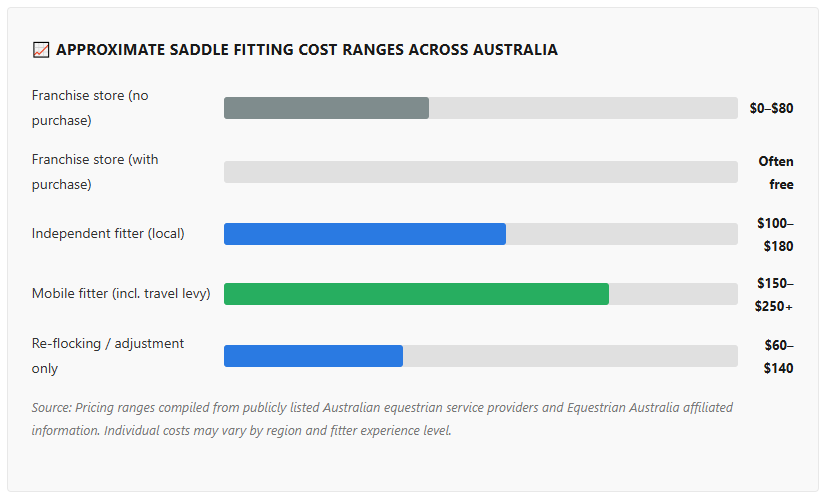
These figures represent a general picture. Rural properties in Western Australia or northern Queensland may attract higher travel fees. Fitters with SMS accreditation or extensive competition-level experience may charge at the upper end. However, the investment is proportional to the benefit.
Consider what a poor saddle fit actually costs over time. Veterinary assessments, physiotherapy for your horse, reduced performance, and potentially the cost of a replacement saddle entirely — these expenses dwarf a professional fitting fee. Proactive fitting is simply better economics.
When comparing Saddleworld franchise pricing against independent fitting services in Australia, the apparent cost difference often narrows once you factor in the broader picture. A free in-store fitting that results in a mediocre fit is not actually saving you money.
Signs Your Saddle Needs Urgent Reassessment
Knowing when to book a fitting reassessment is just as important as knowing who to book it with. Many Australian riders wait for a crisis. That approach is both unnecessary and costly. Instead, watch for these warning signals regularly.
- Your horse resists being saddled or shows tension during girthing.
- The saddle rocks side to side during walk or trot.
- You notice white hairs appearing under the saddle contact area.
- Your horse’s back feels sore or sensitive to the touch after riding.
- Your horse bucks, resists canter transitions, or hollows its back.
- Your saddle tips forward or backward more than previously.
- You notice muscle loss or asymmetry along the horse’s topline.
- Your own position feels unbalanced or unstable despite correct riding.
“A horse cannot tell you the saddle hurts in words. But it tells you in its body every single time it is ridden. Listen to those signals before they escalate.”— Equine Welfare Guidance, RSPCA Australia
Additionally, regular reassessment should occur proactively — not only reactively. Horses in consistent work should have their saddle assessed at least annually. Horses that are young, recently changed weight, or returning from rest need checks every six months at minimum.
Related: Protect your horse’s comfort with Cheval Sport’s range of leg protection products — supporting your horse from the ground up.
How Saddle Fit Directly Affects Your Horse’s Performance
The link between saddle fit and equine performance is now well established in equine science. An ill-fitting saddle does not simply cause discomfort. It fundamentally alters how your horse moves, carries itself, and responds to your aids.
Pressure points along the trapezius or longissimus muscles restrict the horse’s shoulder swing. Consequently, strides shorten. The horse begins to compensate by tensing its back, which limits swing and engagement from behind. Over time, this compensation pattern becomes habitual — and correcting it requires both a properly fitted saddle and remedial body work.
Verified Fact
Research published by the International Society for Equitation Science confirms that saddle fit directly influences spinal kinematics in horses. Poor fit reduces back motion and negatively affects both horse welfare and ridden performance. Source: ISES, Equitation Science Research.
Furthermore, saddle imbalance affects the rider. A saddle that tips forward throws the rider’s weight onto the horse’s forehand. This unintentionally overloads exactly the area you are trying to lighten. Conversely, a saddle sitting too high at the pommel pushes the rider backward, creating a chair seat and disconnecting the aids.
Whether you ride dressage, show jumping, trail, or endurance, saddle fit is not a luxury consideration. It is foundational to every training goal you have. This is why working with a genuinely qualified fitter — independent or otherwise — matters so much more than simply choosing the nearest or cheapest option.
Explore: Cheval Sport’s collection of stirrups and stirrup leathers — proper stirrup fit supports rider balance and saddle stability together.
How to Find a Good Independent Saddle Fitter Across Australia
Finding a reliable, qualified saddle fitter in Australia takes a little research. However, the process is straightforward once you know where to look. Start with your riding network — coaches, riding clubs, and equestrian centres often maintain lists of trusted local practitioners.
- Ask your riding instructor or coach for personal referrals to qualified fitters.
- Contact your local branch of Equestrian Australia for registered service providers.
- Check whether the fitter holds SMS accreditation or Australian equivalent credentials.
- Read reviews on equestrian forums and Facebook groups specific to your state.
- Request a pre-booking consultation — credible fitters are happy to discuss their method.
- Confirm whether the fitter carries a range of demo saddles for your horse to trial.
When searching for a saddle fitting service near you in Australia, refine your search by discipline. A fitter specialising in western saddles will not necessarily have the depth of knowledge required for an elite dressage fitting, and vice versa.
Also, do not overlook the value of your local equestrian retailer as a starting point. Stores like Cheval Sport maintain close relationships with equestrian professionals and can point you toward trustworthy fitting services in your region.
Caring for Your Saddle Between Professional Fittings
A well-fitted saddle still needs maintenance between appointments. Leather saddles, in particular, require consistent conditioning to maintain the integrity of the panels, tree structure, and stitching that all contribute to a stable fit.
Dry, cracked leather panels lose their ability to conform smoothly to the horse’s back. Consequently, even a perfectly fitted saddle begins to create uneven pressure points as the leather deteriorates. Regular cleaning and conditioning prevents this deterioration and extends the service life of the saddle significantly.
- Clean leather saddles after every ride using a damp cloth or appropriate cleaner.
- Condition the leather weekly — or more often in dry Australian climates.
- Inspect stitching, billets, and panel seams monthly for wear or separation.
- Store saddles on a proper saddle rack in a dry, ventilated space.
- Avoid leaving saddles in direct sunlight or in hot vehicle boots.
Shop now: Browse Cheval Sport’s full range of leather care products — keeping your saddle in optimal condition between fittings.
Additionally, wool-flocked saddles require periodic re-flocking as the wool compresses with use. This is a service any qualified saddle fitter — independent or franchise-based — can provide. It is far less expensive than a new saddle and can restore a well-fitted saddle to excellent condition.
Beyond the Saddle — Completing the Picture for Your Horse’s Comfort
Saddle fitting does not exist in isolation. Every piece of equipment your horse wears contributes to the overall comfort picture. Bridle fit, bit choice, girth selection, and rug fit all interact with how your horse feels and performs under saddle.
A horse carrying the discomfort of an ill-fitting bridle may resist the bit in ways that appear to be saddle-related. Similarly, a rug that sits incorrectly over the wither can interfere with shoulder freedom and create soreness that mimics saddle-related pain. Addressing these elements together gives you a complete welfare picture.
- Bridles and headstalls — fit matters as much as function.
- Horse rugs — wither clearance and shoulder fit directly affect movement.
- Horse care products — supporting recovery and comfort after work.
- Rider accessories — rider balance and stability support correct saddle function.
Furthermore, rein choice and weight affect contact consistency, which interacts with how the horse carries itself — and therefore how the saddle moves. Thinking holistically about your horse’s gear is not overcautious. It is simply good horsemanship.
Frequently Asked Questions About Saddle Fitting in Australia
Independent fitters carry no obligation to sell you a particular brand. They assess your horse objectively. Store fitters may be knowledgeable, but their inventory limits their options. For a genuinely unbiased outcome, an independent fitter is usually the stronger choice.
Professional saddle fitting in Australia typically costs between $100 and $250 for a standalone assessment. Mobile fitters may add a travel levy. Some franchise stores offer fitting as part of a saddle purchase, but standalone independent assessments carry a separate fee.
Bias is a real structural concern. An in-store fitter can only recommend saddles from that store’s range. Even well-intentioned fitters work within stock constraints. An independent fitter has no financial reason to favour one brand over another.
Ask for formal qualifications from a recognised body such as the Society of Master Saddlers. A credible fitter will readily share their credentials and ongoing professional development history. Do not accept vague references to “brand training” as the sole qualification.
Policies vary between franchise locations. Some offer complimentary fitting with a saddle purchase, while others charge for standalone assessments. Always confirm the cost upfront before attending your appointment.
A mobile fitter travels to your property and assesses the saddle dynamically — on your horse, in its usual environment. An in-store appointment uses measurements and templates without capturing real-world movement. Mobile fitting typically delivers a more accurate result.
Most equine professionals recommend reassessment every six to twelve months. Young horses, horses in heavy training, or horses that have changed weight may need more frequent checks.
Yes. Independent fitters routinely assess, adjust, and re-flock saddles regardless of where they were purchased. This is one of their key advantages over store-based fitting services.
Many franchise store fitters are knowledgeable and well-trained. Trustworthiness depends on the individual fitter’s qualifications and experience. Verify credentials and understand that stock constraints may influence recommendations.
Search through Equestrian Australia’s network, ask your riding club for recommendations, or consult equestrian retailers like Cheval Sport who can connect you with trusted professionals in your area.
Many mobile and independent fitters carry demo saddles for trialling. Confirm this when booking so you know what options will be available during the visit.
Yes. Sustained pressure from an ill-fitting saddle causes muscle atrophy, white hairs, back soreness, and behavioural problems. Early detection through regular fitting checks prevents long-term damage.
Absolutely. Weight gain changes the shape of the horse’s back and shoulder profile. A saddle that fit correctly at a lower weight may pinch or create pressure points after significant weight gain. Book a check promptly if your horse’s condition has changed.
Coverage varies by policy. Some Australian equine insurance providers include preventive care provisions that may cover fitting assessments. Check your policy documents or contact your insurer directly for clarification.
Final Thoughts — Make an Informed Choice About Saddle Fitting
Saddleworld in Australia offers accessibility and convenience that suits many riders. However, convenience should never override accuracy — especially where your horse’s welfare is at stake. Understanding the structural difference between franchise fitting and independent assessment puts you in the best possible position to make the right call.
An independent, qualified saddle fitter gives you brand-neutral advice. A mobile fitter adds the dimension of dynamic, real-world assessment. Both options, when done well, deliver far more than a free in-store fitting that simply matches you to whatever is currently in stock.
Equally, maintaining your saddle and associated tack between professional appointments protects the investment you have made. Proper leather care, regular bridle checks, and thoughtful rug selection all contribute to a horse that is genuinely comfortable under saddle — not just tolerating it.
For quality equestrian gear that supports your horse from the saddle pad to the stirrup iron, explore the full range at Cheval Sport — your trusted Australian equestrian supplier based in Yan Yean, Victoria.