
Most riders think their horse is being difficult.
Resistant at the canter transition. Pinning ears when the girth goes on. Hollowing through the back. Refusing to go forward freely.
In many cases, the horse is not being difficult. The saddle is the problem.
A poorly fitting saddle creates pressure points on the horse’s back. It restricts shoulder movement. It shifts the rider’s weight in ways that make it physically hard for the horse to do what is being asked. The horse is not resisting. It is trying to tell you something.
The most expensive mistake in equestrian sport is not buying the wrong saddle. It is buying the wrong saddle and not realising it for two years. This guide covers everything you need to know before buying a horse saddle in Australia — the types, the fit basics, the difference between disciplines, what specific products are worth knowing about, and the questions to ask before spending serious money on a piece of leather your horse will live in every ride.
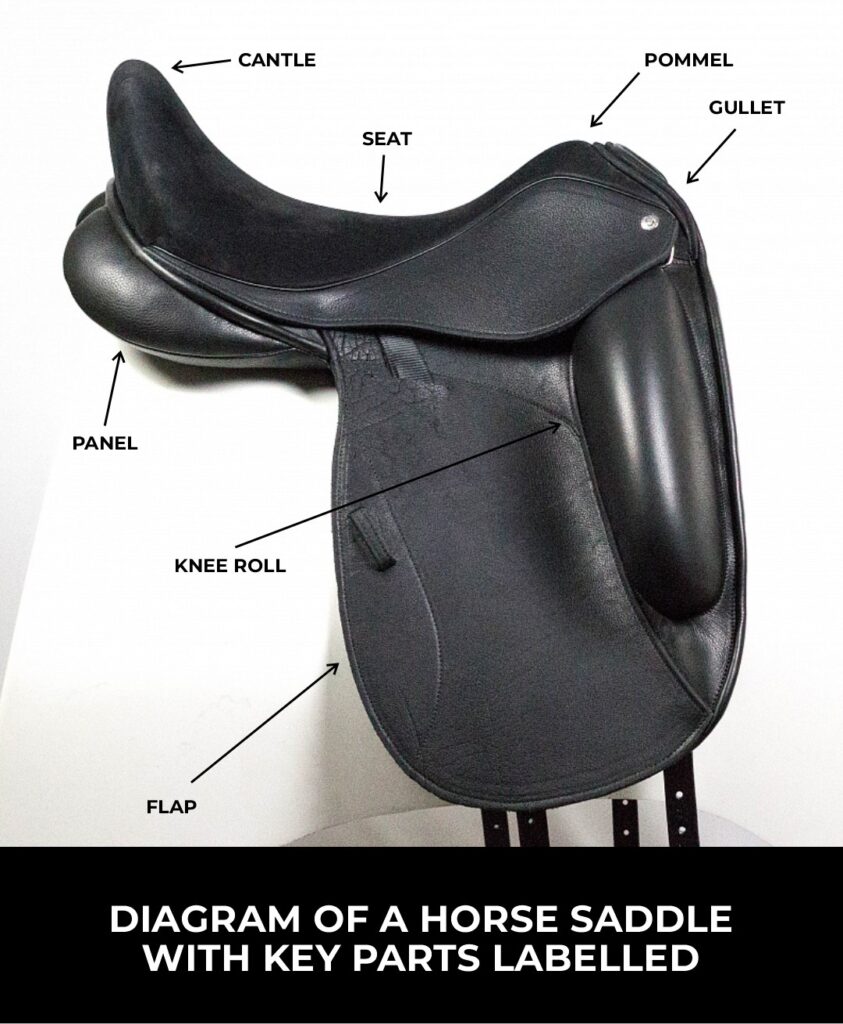
The Three Things Every Saddle Must Do
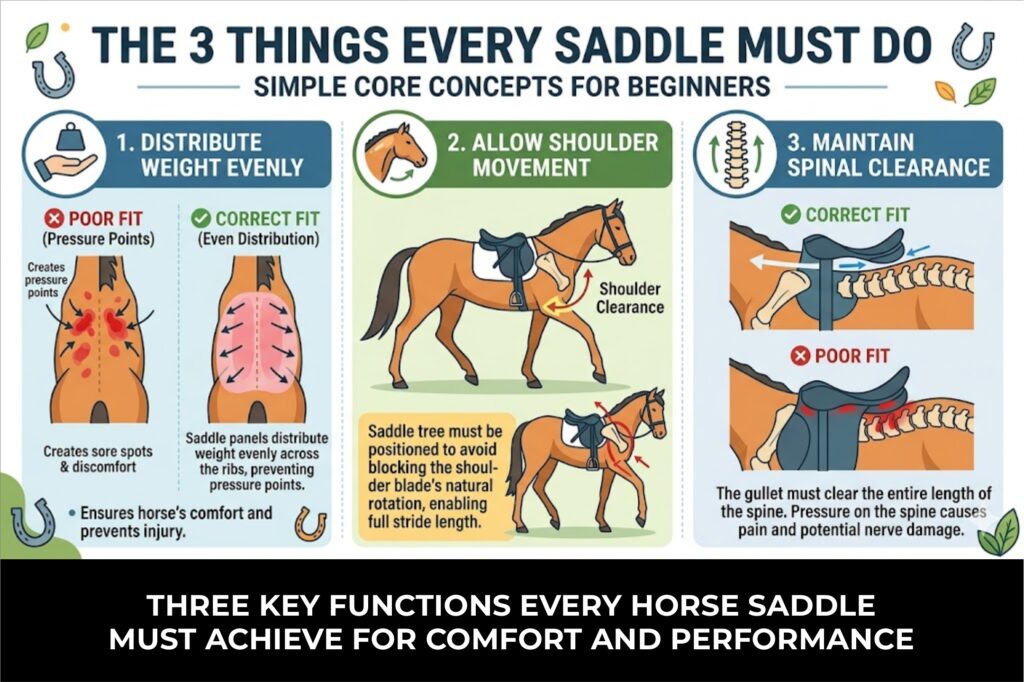
Before you look at brand, style, or price, understand what a saddle is actually supposed to achieve.
1. Distribute the Rider’s Weight Evenly
A rider in a saddle creates a concentrated load on the horse’s back. The saddle’s panels (the padded undersides that contact the horse’s back) must spread that load evenly. When this works, the horse carries the rider without localised pressure. When it does not, you get soreness, tension, and resistance.
2. Allow Full Shoulder Movement
The saddle must sit far enough back that the front of the panel does not restrict the horse’s shoulder blade as it rotates during movement. A saddle sitting too far forward is one of the most common fitting errors. Check by running two fingers behind the shoulder blade with the saddle in place — there should be clearance.
3. Maintain a Clear Channel Over the Spine
The gullet (the channel through the centre of the saddle’s underside) must clear the horse’s spine completely. No part of the saddle should press down onto the spinous processes (the bony projections along the top of the spine). Spinal pressure causes pain, damage, and serious behavioural problems.
Fit basics understood. But here is the part most buyers skip — and it is the part that determines whether the saddle works for what you actually do.
Saddle Types — Which One Do You Actually Need?
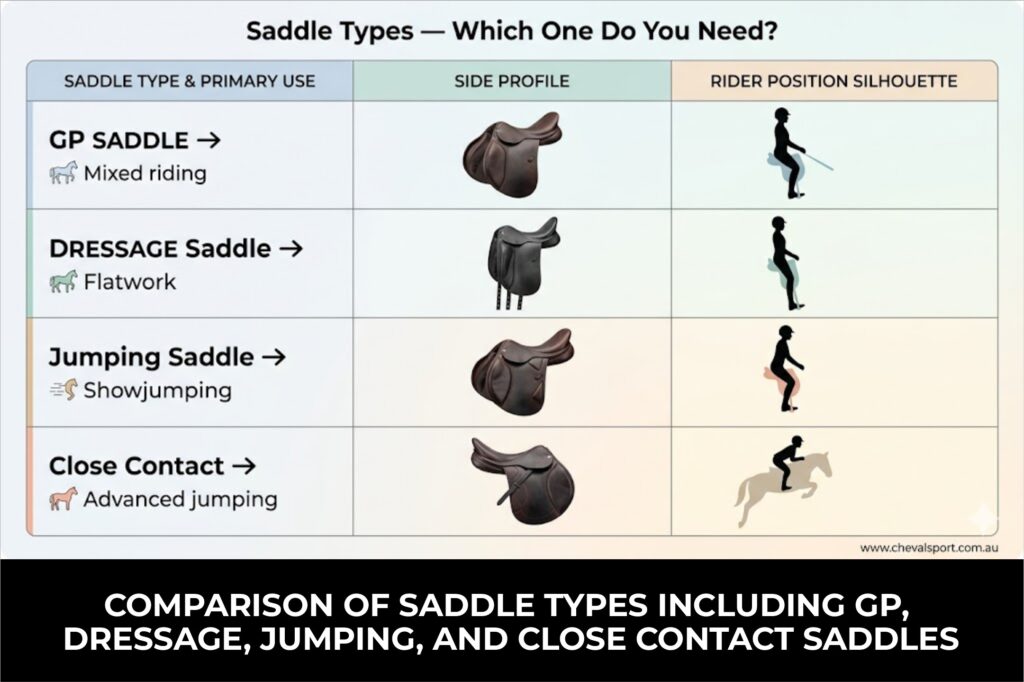
· General Purpose (GP) Saddle
The most versatile saddle available. Designed to work across flatwork, light jumping, trail riding, and general use. The flap angle is moderate — not as forward as a jumping saddle, not as straight as a dressage saddle.
Best for: Riders who do a mix of activities. Young horses in early training. Recreational riders not competing in a single discipline.
· Dressage Saddle
Designed specifically for flatwork and dressage. The straighter flap places the rider’s leg in a longer, more vertical position — the classical dressage seat. The deeper seat keeps the rider centred and still through collected movements.
Best for: Riders training and competing in dressage from Preliminary level upward. Any rider working on position and collection.
At the mid-to-premium level, the Frank Baines Adagio Dressage and Frank Baines Operetta Dressage are two of the most respected dressage saddles available in Australia. Both are built on quality European leather and are favoured by riders from Amateur to Grand Prix level. At the top of the range, the Kieffer Paris Dressage with Drop Panel ($5,995) is a competition-level saddle with a monoflap design that gives exceptional leg contact and feel. For riders wanting a bespoke option, the Hastilow Bentley Dressage Saddle ($5,900) is custom-built to the individual horse and rider.
· Jumping and Close Contact Saddles
A forward-flap design that positions the rider over shorter stirrups and a more two-point position (weight in the stirrups, light contact with the seat). Designed to follow the horse’s movement over a fence. Close contact versions offer a flatter profile for maximum feel.
Best for: Showjumping, eventing cross-country, and riders doing significant jumping work.
| Saddle Type | Flap Angle | Seat Depth | Best Use |
| General Purpose | Moderate | Medium | Flatwork, light jumping, trail, mixed use |
| Dressage | Straight | Deep | Dressage training and competition |
| Jumping | Forward | Shallow to medium | Showjumping, eventing jumping phase |
| Close Contact | Very forward | Flat | Advanced jumping, eventing cross-country |
Type selected. Now the question that determines whether the saddle you buy actually fits the horse you have.
Saddle Fit — The Basics Every Buyer Must Understand
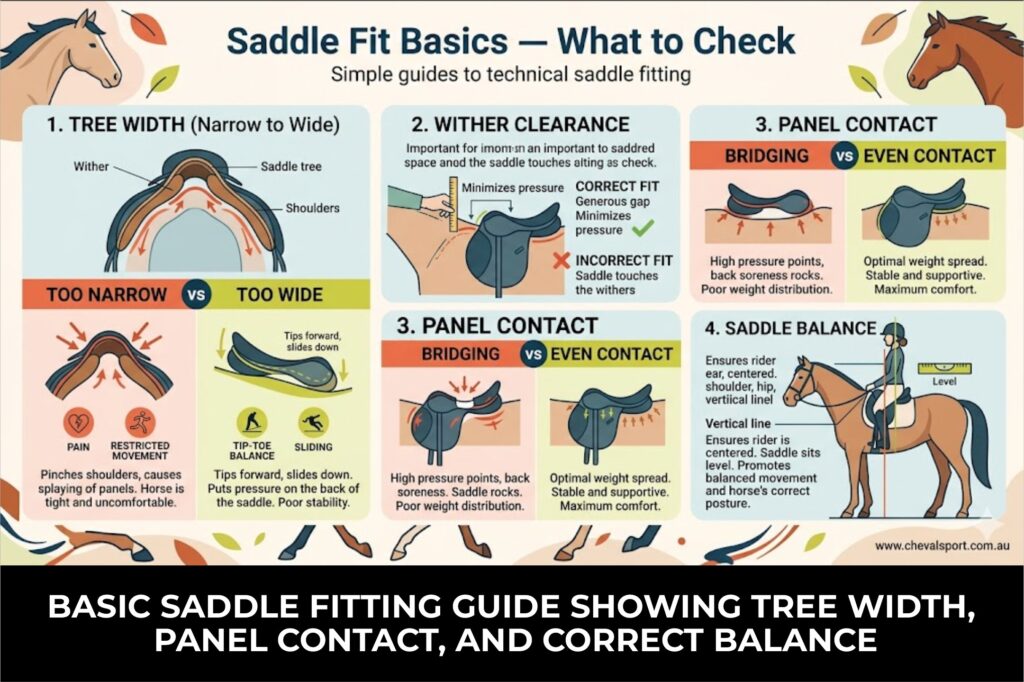
Saddle fit is a specialist skill. A qualified saddle fitter should be involved in any significant saddle purchase. But understanding the basics helps you ask better questions and recognise problems early.
Tree Width and Wither Clearance
The tree is the internal frame the saddle is built around. Tree width determines how the saddle sits on the horse’s back. Too narrow and it pinches the withers (the highest point of the horse’s back at the base of the neck). Too wide and it drops down onto the spine.
Tree widths are described as Narrow, Medium, Wide, and Extra Wide (N, M, W, XW). Horses vary enormously — a 16.2hh warmblood and a 16.2hh thoroughbred will often need completely different tree widths despite the same height.
Panel Contact and Balance
The panels must make even, full contact along their entire length — not bridging (where the centre lifts off while front and back contact) and not rocking (tilting side to side). A balanced saddle sits with the deepest point of the seat at the centre.
Rider Seat Size
Saddle seat sizes run from 16 to 18 inches for adults. The rider should be able to fit four fingers between their knee and the front of the flap when in correct position, without being forced back into the cantle.
One often-overlooked saddle fit factor is girth design. A poorly designed girth can pull the saddle forward, undoing even a correct saddle fit. The Total Saddle Fit StretchTec Shoulder Relief Dressage Girth ($399) is specifically designed to sit behind the shoulder and avoid the shoulder contact point — useful for horses who show reluctance when girthy (reactive around the girth area), or for saddles that tend to migrate forward during work.
| Always Use a Qualified Saddle Fitter No online guide replaces a professional fitter assessing your horse in person. A proper fitting takes 60 to 90 minutes and should include watching the horse move with and without the saddle. In Australia, look for fitters with manufacturer training from the brands you are considering — Bliss of London, Frank Baines, and Kieffer all have accredited fitters available. |
Leather vs Synthetic — Which Saddle Material Is Right for You?
■ Leather
Full leather saddles are the traditional and still-preferred choice for most serious riders. Leather moulds to horse and rider over time, provides excellent grip and feel, and with proper care will last decades. The best leather saddles are made from European cattle hide — denser, more consistent, and more durable than lighter hides.
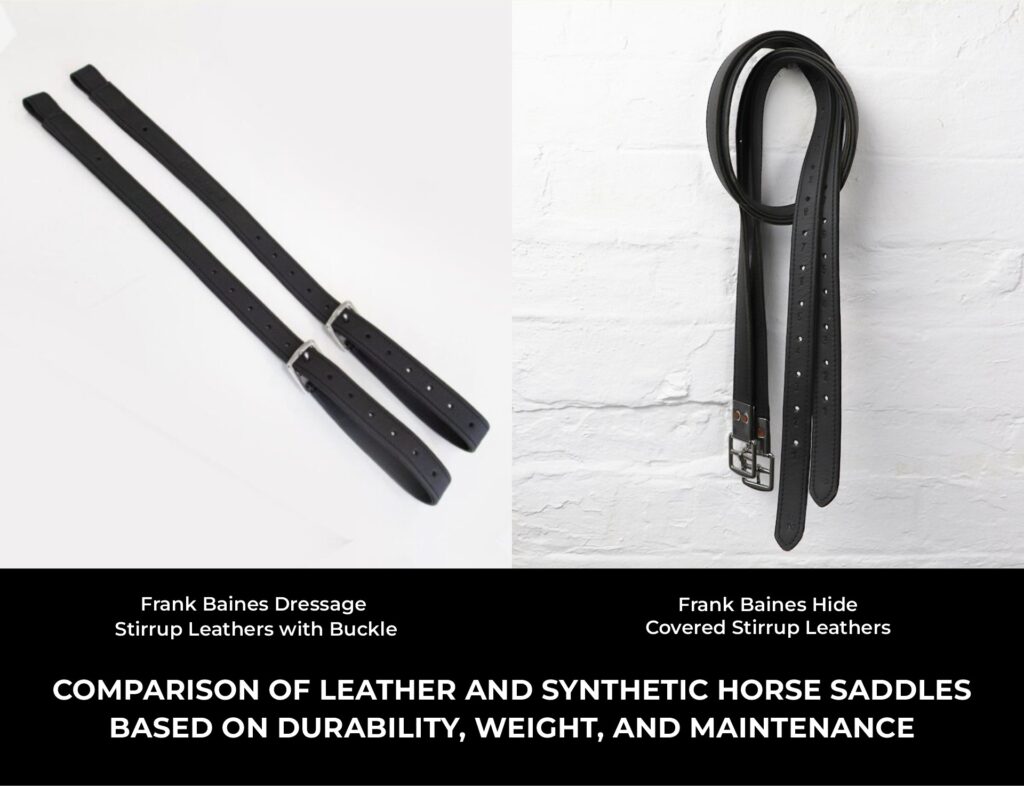
Brands like Frank Baines, Bliss of London, and Kieffer use high-quality European leather. These are investment purchases, but the longevity and performance justify the price for regular riders. Also worth considering: the Frank Baines range of saddle accessories, including the Frank Baines Dressage Stirrup Leathers with Buckle ($210) and the Frank Baines Hide Covered Stirrup Leathers ($199) — matching leathers cut from the same quality hide as the saddles.
■ Synthetic
Synthetic saddles are lighter, easier to clean, and significantly less expensive. Wintec’s CAIR system allows tree width to be changed with an Allen key — useful for growing horses or owners with multiple horses of different builds. For casual and recreational riders, the practicality often outweighs the feel difference. For competitive dressage riders, leather is almost universally preferred.
What Does a Quality Horse Saddle Cost in Australia?
| Category | Price Range (AUD) | Examples at Cheval Sport |
| Entry-level synthetic | $400 to $900 | Wintec range — adjustable tree, easy care |
| Mid-range leather GP / dressage | $1,500 to $3,500 | Frank Baines Adagio, Envy Aurora, Envy Motion |
| Premium dressage | $4,000 to $6,500 | Kieffer Paris ($5,995), Hastilow Bentley ($5,900), Bliss of London Loxley |
| Custom made / bespoke | $5,000 to $10,000+ | Custom Saddlery range, Sankey Petite Dressage |
5 Mistakes Australian Riders Make When Buying a Saddle
• Buying online without a fitting. Photos and measurements are not a substitute for a qualified saddle fitter assessing your horse in person.
• Choosing seat size by height alone. Body proportions — thigh length, hip width, pelvis shape — matter as much as overall height.
• Not accounting for how the horse’s back changes. Young horses develop significant muscle in their first 3 to 4 years. A saddle that fits at 4 may not fit at 7.
• Skipping saddle checks after weight changes. Condition changes affect back shape and therefore saddle fit. Annual checks are the minimum.
• Buying second-hand without checking the tree. A damaged tree cannot be reliably repaired. Always have second-hand saddles inspected by a qualified fitter before use.
Conclusion
Choosing the right horse saddle is not about finding the most expensive option. It is about finding the combination of type, fit, and material that works for your horse’s back, your riding discipline, and your goals.
Get the fit right first. Then choose the type that matches what you are training for. The brand and price range follow from there — and there are excellent options at every level.
Explore the full saddle range at Cheval Sport — including Frank Baines, Bliss of London, Kieffer, Envy, Hastilow Bentley, and custom saddlery options — all available online with expert advice on fitting.