
Most riders choose a bridle the way they choose a rug — by how it looks on the horse.
That is not entirely wrong. Appearance matters in the competition arena. But a bridle that does not fit correctly, or that is not appropriate for the horse’s training level, does far more damage than a poorly matched colour combination.
The bridle is your primary communication tool. Every rein aid, every half-halt (a subtle signal to rebalance the horse), every request for collection passes through it. A bridle that does not fit creates pressure in the wrong places, dulls communication, and can make a willing horse resistant for reasons neither rider nor trainer can easily explain.
The bridle is not decoration. It is the most important communication device between horse and rider.
This guide covers the main bridle types, what fit actually means, and the rein choices that affect how aids are received.
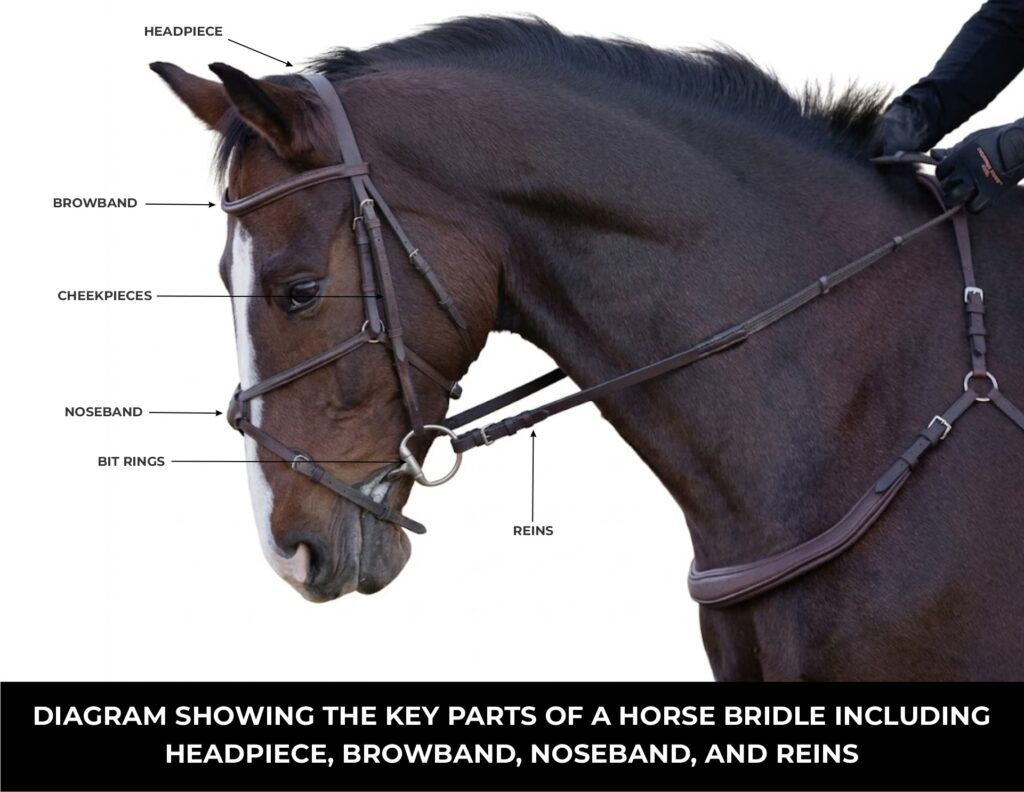
What is a Horse Bridle? (Quick Answer)
A horse bridle is a piece of equipment used to control and communicate with a horse through the bit, reins, and headgear. It allows the rider to give precise signals that guide the horse’s movement, balance, and responsiveness.
The Main Bridle Types
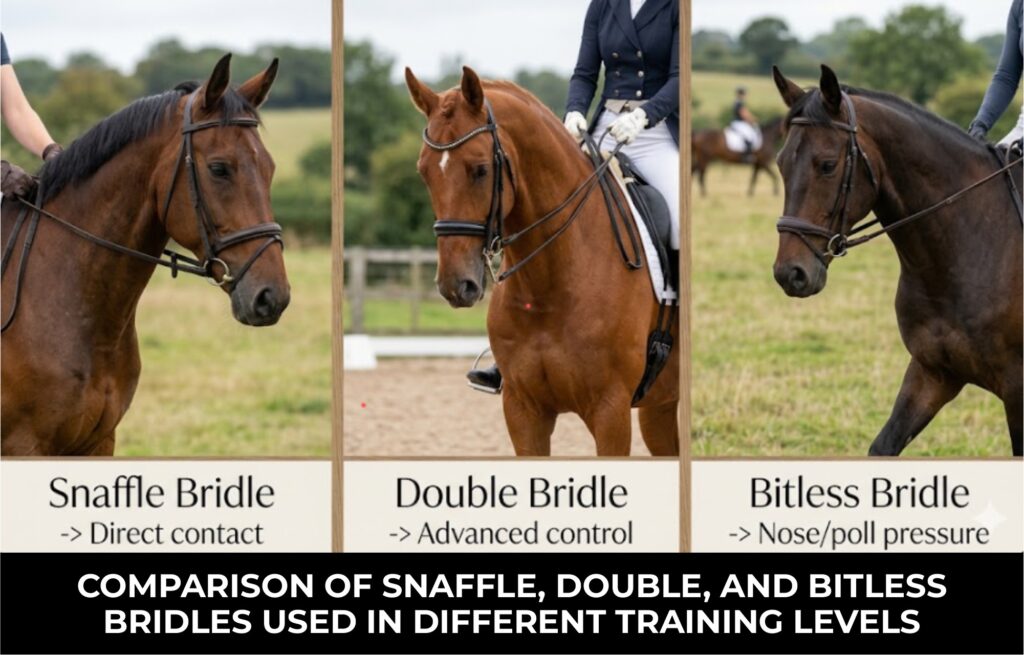
Snaffle Bridle
The noseband — the strap that runs around the horse’s nose — is the variable element. It can be a simple cavesson (flat noseband), a drop noseband, a flash noseband (cavesson with an additional strap under the bit), or a crank noseband (adjustable for tighter fit). Each affects how much freedom of jaw movement the horse has.
Double Bridle (Weymouth Bridle)
Used at advanced dressage levels — from Prix St Georges upward. A double bridle carries two bits simultaneously: a bradoon (a thin snaffle) and a Weymouth (a curb bit that applies leverage). The rider uses two sets of reins. The bridle is not an upgrade from a snaffle — it is a tool for horses whose training has reached the level where the additional refinement of aids it allows is appropriate.
The standard bridle for horses in early and mid-level training. Uses a single bit with direct rein contact — the rein attaches directly to the bit ring with no leverage. The snaffle is the most widely used bridle type in dressage, showjumping, and general riding. All horses begin their training in a snaffle and most recreational horses stay in one throughout their ridden life.
Using a double bridle on a horse that is not ready for it causes confusion and resistance. It is a precision instrument, not a short cut.
Bitless Bridle
Communicates via nose and poll pressure (pressure on the top of the head) rather than bit contact. Used in some disciplines and for horses with mouth issues, dental problems, or retraining situations. Not permitted in FEI or most EA competition classes.
UNIQ Bridles — Bespoke Quality Available at Cheval Sport
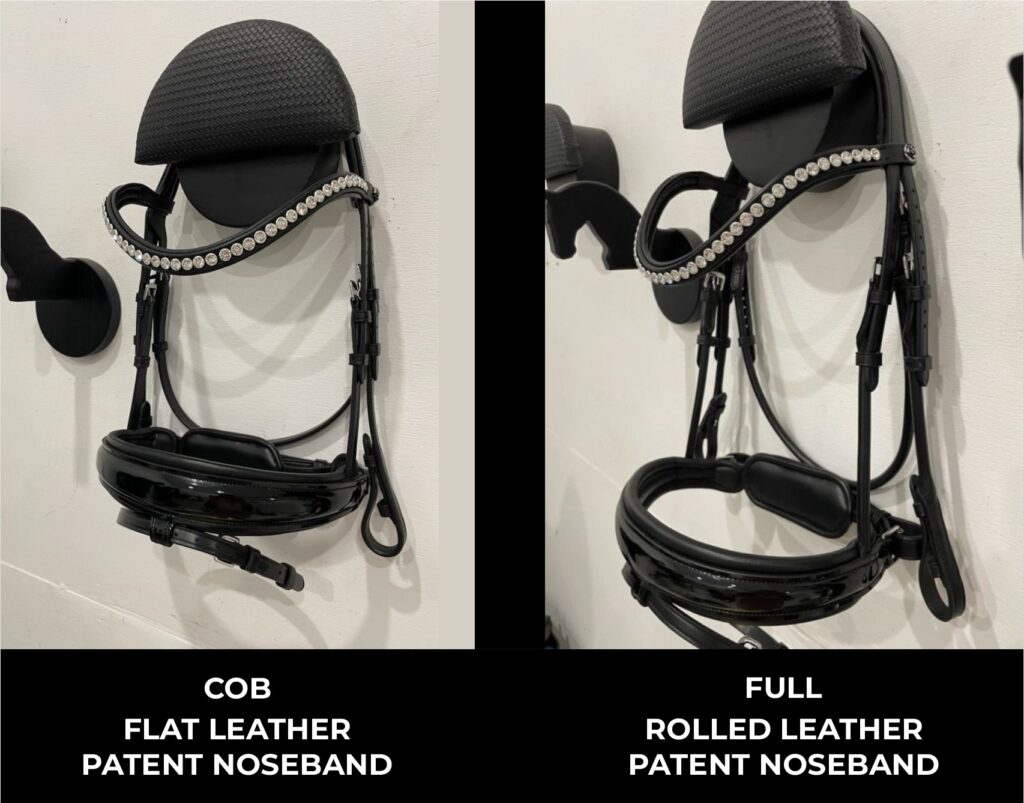
Cheval Sport stocks the UNIQ Bridles range — bespoke bridles combining quality craftsmanship, durability, and refined equestrian style. The UNIQ range covers both snaffle and double configurations, with hand-selected leather and attention to anatomical fit.
Two products from the UNIQ range worth knowing: the COMFORT Snaffle bridle with Flat Leather and Patent Noseband ($495, COB size) and the COMFORT Snaffle with Rolled Leather and Patent Noseband ($495, FULL size). Both feature the anatomical headpiece design that reduces poll pressure — relevant for horses that are sensitive at the poll (the area between the ears) or that show head-tilting or resistance to contact.
Bridle type understood. The part most riders overlook is what actually connects the bridle to the horse’s responsiveness — the reins.This is where even experienced riders make mistakes.
Reins — How Your Choice Affects Communication
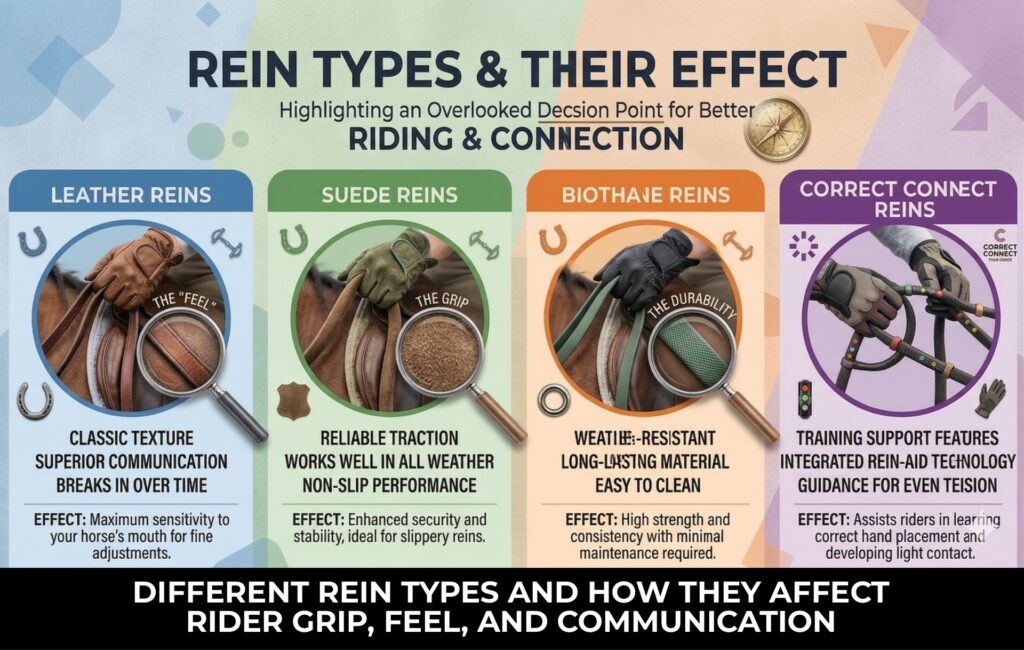
The rein is the physical link between rider hand and horse mouth. Rein material and grip affect how clearly aids are transmitted and received.
Leather Reins
The traditional choice. Quality leather reins provide excellent feel and are the preference for dressage competition. The UNIQ Leather Reins (Snaffle or Double, $140 to $150) and UNIQ Soft Suede Reins ($150) offer refined hand feel with quality construction. The UNIQ Biothane Reins in Black ($150 to $160) provide a synthetic alternative that is waterproof and easy to clean — useful for training in variable weather.
Correct Connect Reins — A Training Tool Worth Understanding
The Correct Connect range is designed specifically to help riders develop a steadier, more consistent contact with the horse’s mouth. The system uses hand grips positioned along the rein to give the rider tactile feedback about hand position and stability.
The Correct Connect Aaron Vale rein with 3 Slim Hand Grips ($260) is the most popular option — three grips that help the rider maintain consistent spacing and avoid the common error of creeping hands. The Padded Hand Grips version ($280) adds grip cushioning for riders who struggle with sustained contact.
Bridle Fit — What You Are Actually Checking
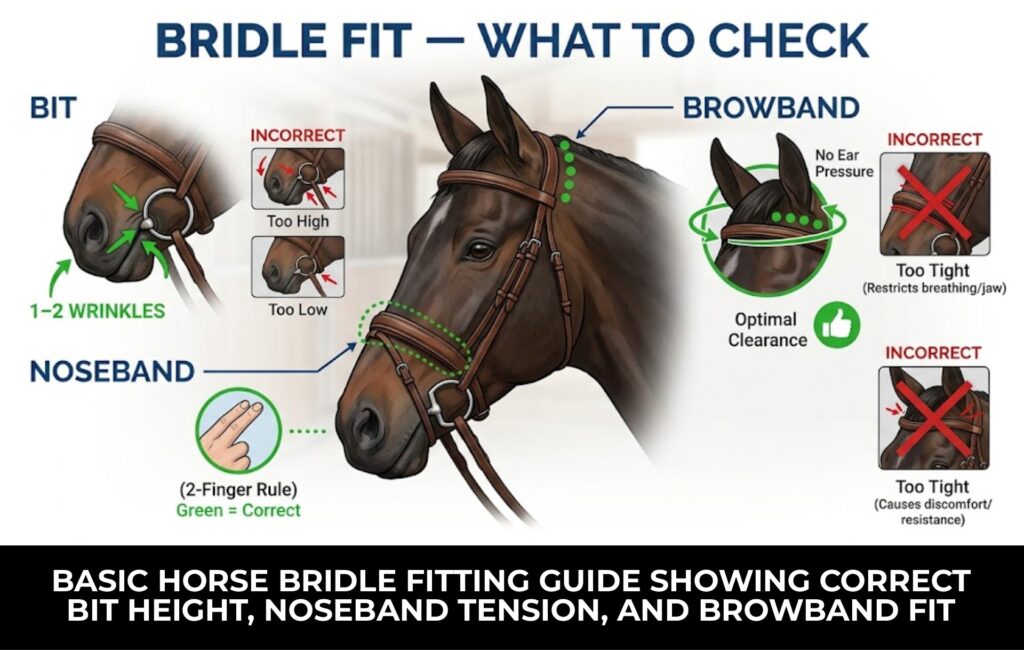
A bridle that does not fit creates unnecessary pressure that interferes with communication and comfort. If your saddle and saddle pad are not working correctly, even a well-fitted horse bridle will not solve communication issues.Here is what to check.
Bit Height
The bit should sit in the corners of the mouth creating one or two light wrinkles (smile lines). Too high and it creates constant pressure. Too low and the horse can get its tongue over the bit — a problem that is difficult to correct once established.
Noseband Fit
The noseband should allow two fingers to fit between it and the nose. A noseband that is too tight restricts jaw movement, which affects the horse’s ability to accept contact and swing through the back. A noseband that is too loose has no meaningful effect and shifts position during work.
Browband Length
The browband should sit flat across the forehead without pulling the headpiece forward toward the ears. A browband that is too short pulls the headpiece into the back of the ears — a pressure point that causes headshaking, ear-pinning, and resistance to being bridled.
Browbands are also a point of individual expression — particularly in dressage, where a crystal or decorative browband is standard at competition level. The UNIQ Browband in Black Crystal Rock ($240, Large) is the competition-level option available at Cheval Sport — handcrafted, with black and clear crystals on a black leather base. It pairs directly with the UNIQ bridle range and fits most full-sized horses.
A rider whose horse had started refusing to be bridled — backing away and flipping its head — had the browband checked by her trainer. It was one size too small. The headpiece had been sitting against the base of the horse’s ears for every ride. Once replaced with a correctly fitting browband, the horse accepted bridling without resistance within three sessions.
Common Horse Bridle Mistakes Riders Make
- Choosing a bridle based on appearance only
- Using a double bridle too early in training
- Over-tightening the noseband
- Ignoring browband fit
- Using reins that do not suit their riding style
Conclusion
A horse bridle is not chosen once and forgotten. It should be checked for fit regularly — horses change shape as their muscling develops and their head changes with age and condition.
Choose the type appropriate for the horse’s training level. Fit each component properly. Choose reins that match how you ride and what you are training. The bridle is the most direct communication link you have — it deserves the same thought as any other piece of equipment in your kit.
Browse the UNIQ Bridles range, Correct Connect reins, and the full bridle collection at Cheval Sport.